
The True Cost of "Free" Rags in a Workshop
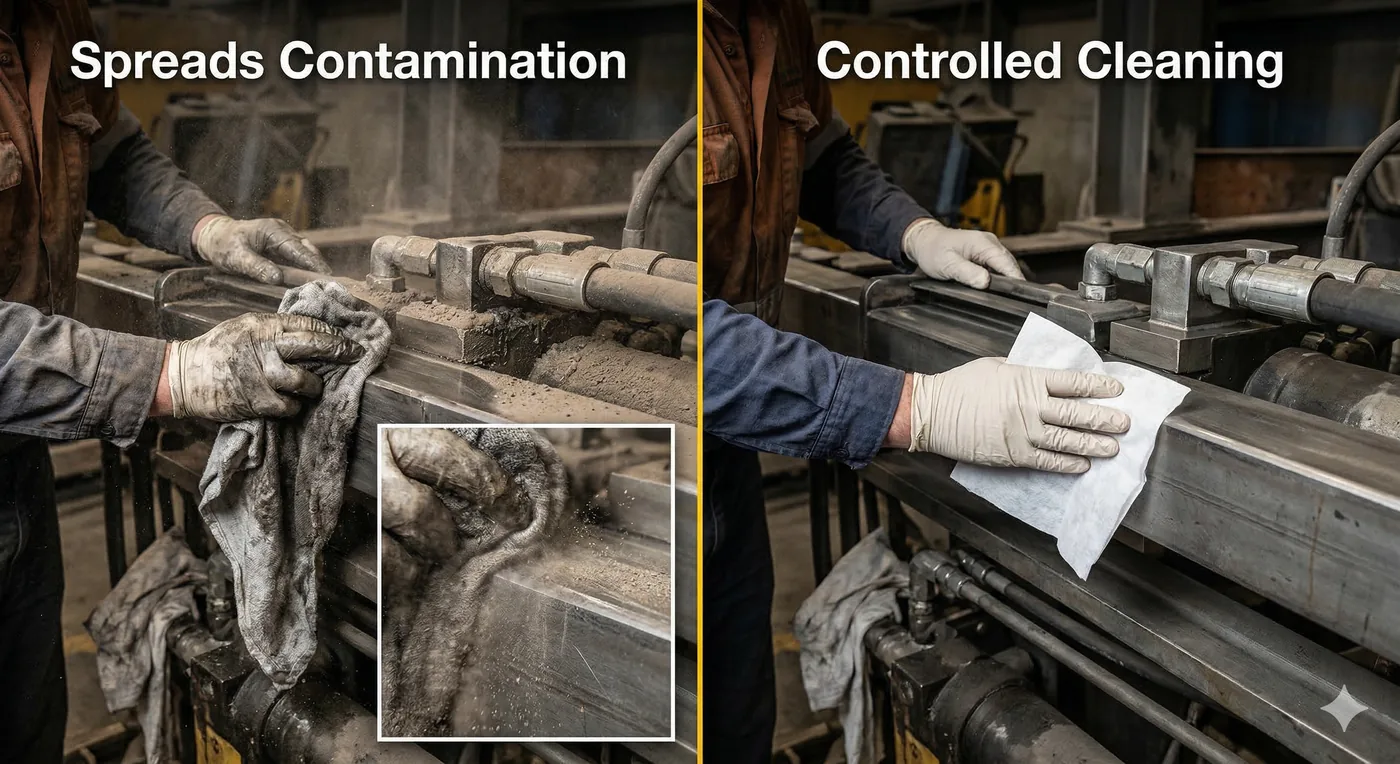
Shop rags feel free. They're not. The rag itself might cost nothing, but everything around it does — laundry, contamination, downtime and disposal. Add it up and "free" rags are often the most expensive way to clean a workshop.
Where the cost actually sits
The price of the rag is the smallest line in the equation. The real spend hides in the system around it:
- Laundry and rental. Rag services charge per kilo or per cycle, every week, forever. Buy your own and you pay to wash, dry and store them — plus the water, power and labour.
- Replacement and shrinkage. Rags walk off, get binned, or come back too far gone to use. The pile is never the size you paid for.
- Contamination. A laundered rag carries whatever the last job left behind — fine grit, metal particles, old grease. You're not cleaning a surface, you're moving contamination around it.
- Downtime. Inconsistent rags mean a second pass, a re-clean, or a part that fails inspection. Every re-do is paid labour.
- Disposal. Oily, solvent-soaked rags are a regulated waste stream and a fire risk. Bins, pickups and compliance all carry a cost.
The contamination tax
This is the one nobody puts on the invoice. A rag that has cleaned a brake job and gone through a wash still holds abrasive particles. Use it on a sealing face, a hydraulic fitting or a painted panel and you've introduced the exact contamination you were trying to remove. The cost shows up later — as a leak, a scratch, or a warranty claim.
The downtime you don't measure
Cleaning is dead time. The faster and more consistently it's done, the less it costs. A rag that smears instead of lifts, or tears mid-job, adds minutes to every clean. Multiply that across a bay, a shift and a crew, and the "free" rag is quietly buying back hours you already paid for.
The bin in the corner
A bin of oily rags is a combustion risk and a controlled waste. That means a compliant container, a disposal contract, and a procedure your team has to follow. None of it is free, and the consequences of getting it wrong are a lot more than the cost of a wipe.
What to actually compare
The honest comparison is cost per clean, not cost per rag. A purpose-built wipe costs more per unit and less per job: it lifts contamination instead of spreading it, holds together through the work, needs no laundry, and goes in general waste in most cases. One wipe, one job, no return trip through a washer.
"Free" was never free. It was just billed somewhere you weren't looking.
Work Out Your Real Cost Per Clean
Purion supplies industrial wipes in bulk for workshops and site teams across Australia. Tell us your volume and we'll give you pricing to compare against your current rag spend.